Steamed Buns or Pastries? A Technical Guide to Frozen Cantonese Dim Sum Selection
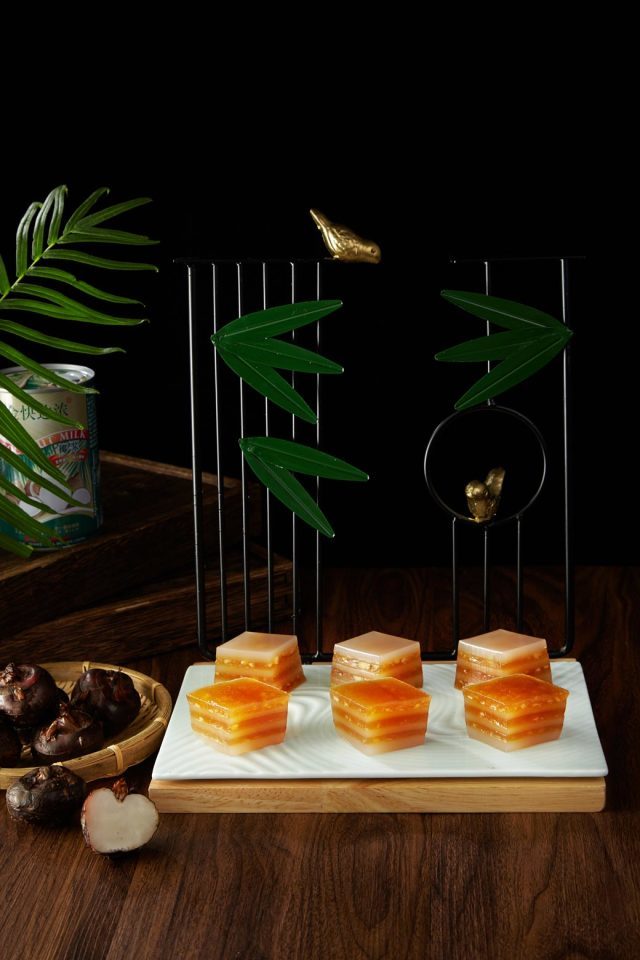
Short answer: the choice between steamed buns and pastry-format Cantonese dim sum is a preparation and inventory decision before it is a flavour decision. Bun-format and steamed savoury items — walnut buns, custard buns, chicken sticky rice, siu mai — suit menus that need satiety, throughput and a 12-month frozen shelf life. Steamed-cake and fried pastry items — water chestnut cake, red bean cake, coconut golden cake, taro cake — suit menus that need differentiation, tea pairing and short, visible preparation: the coconut juice water chestnut cake, for example, is a 500 g bag packed 12 bags per box and steams without thawing in 6–8 minutes.
This guide is written for buyers in the research and evaluation stage who must convert a menu idea into a purchase specification. It sets out the parameters that actually separate the two formats: dough system, pack architecture, heat method and time, frozen shelf life, documentation, and channel fit. Product data below refers to the range of Foshan Shunde Yuexiang Food Manufacturing Co., Ltd. (brand "Da Xiao"), a Cantonese dim sum manufacturer founded in 1981 in Shunde, Foshan, Guangdong Province.
Problem Definition: Why the Format Decision Is Really a Kitchen Decision
In frozen Cantonese dim sum, "steamed buns" and "pastries" describe two different dough and starch systems that behave differently in a commercial kitchen. They are not interchangeable menu items, and they are not priced or scheduled the same way.
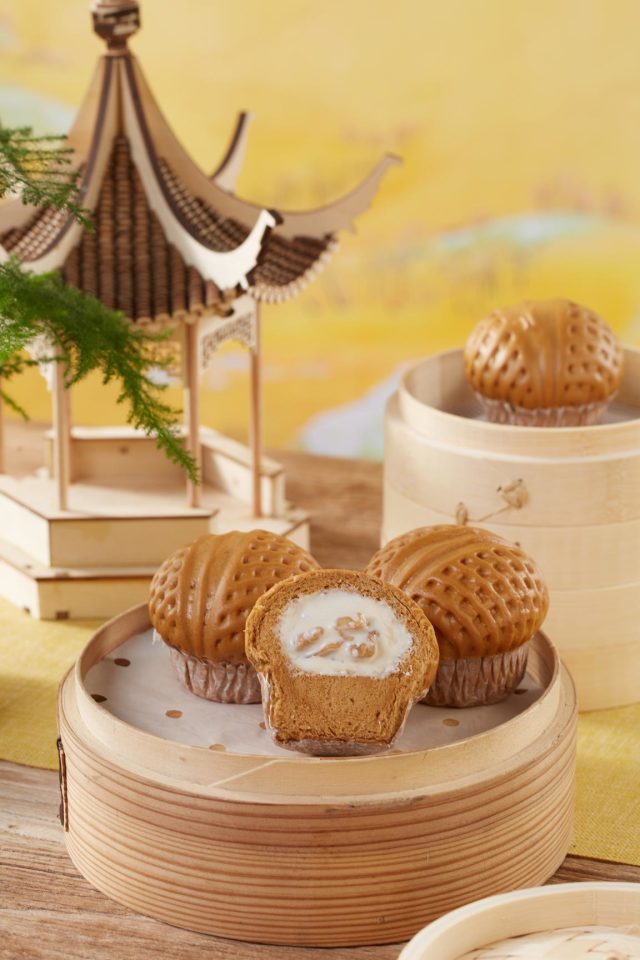
- Steamed bun-format items are built on soft or leavened wheat dough and are sold as a staple. Walnut Bun is a 480 g bag holding 12 pieces, packed 18 bags per box, steamed without thawing for 8 minutes. The steamed custard bun is a 420 g pack of 12 pieces, 18 packs per box, steamed without thawing for 8–10 minutes. The bun family in the wider range also includes barbecued pork buns and red bean paste buns.
- Steamed savoury steam-and-serve items sit in the same operational family but carry far longer cook times. Shrimp Siu Mai is 270 g per pack of 9 pieces, 20 packs per box, steamed without thawing for 12 minutes. Chicken with glutinous rice (chicken sticky rice) is packed either 720 g (6 pieces) per bag or 900 g (6 pieces) per bag, 12 bags per box, and steams without thawing for 20–25 minutes.
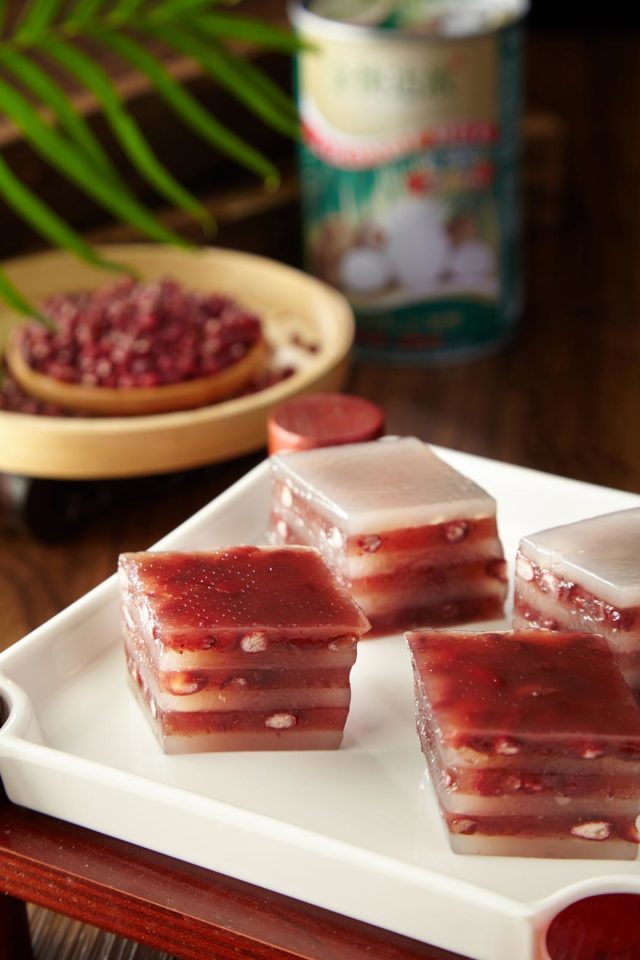
- Pastry-format items are starch- or rice-based cakes and fried pastries used as a tea snack or dessert: Water Chestnut Cake, Red Bean Cake, Coconut Golden Cake, Taro Cake, Green Tea Buddha Cake and Golden Cone Durian Crisp.
Four constraints decide the split in practice. Steam time per batch ranges from 6–8 minutes for cakes to 20–25 minutes for sticky rice. Pieces per bag range from 9 to 12, which changes portion control and reorder rhythm. Frozen shelf life differs — steamed buns are stored at -18 °C with a 12-month shelf life, while steamed cakes such as water chestnut cake, red bean cake and sesame cake carry a 6-month frozen shelf life. And documentation, not flavour, determines whether a product can enter a given market at all.
Industry Background: Scale, Labelling Rules and Export Codes
Frozen Cantonese-style dim sum is a large and still expanding category. Data Insights Reports / Research Insights values the global frozen Cantonese-style dim sum market at USD 7.04 billion in 2025 and projects USD 11.99 billion by 2033. Production is concentrated: Business Research Insights reports that China accounted for 46% of global frozen dumpling production volume in 2025.
Two market-level rules shape how a format decision is documented. Guangzhou introduced the Morning Tea Heritage Protection Regulation effective 1 May 2026, requiring restaurants to clearly label whether dim sum is handmade on-site or produced by central kitchens or as pre-made product. For a buyer, that turns the frozen-versus-handmade question into a declarable menu statement, and it raises the value of a supplier whose production documentation is complete. At the border, frozen dim sum is commonly exported under HS Code 1902200000 (stuffed pasta) and 1902309000 (other pasta).
The manufacturing base matters as much as the market data. Shunde, in Foshan, Guangdong, is recognised by UNESCO as a "City of Gastronomy", and it is where Yuexiang Food has operated since 1981 as a "Foshan Time-Honored Brand" and a member of the Cantonese Pastry Chefs Association. The company runs a 20,000 m² automated facility with 200+ employees and 30+ R&D engineers, offers more than 300 items across five major series, and exports to 20+ countries, with an export ratio of 40% and main markets in Southeast Asia, Europe and the Americas.
Selection Parameters: What to Compare Between Steamed and Pastry Formats
1. Dough system, texture and sweetness profile
The texture target should be written into the specification, because it drives how the item is plated and which customer it serves. Walnut Bun pairs a soft, milky white dough with a white chocolate and chopped walnut filling — soft outside, crunchy inside. Water Chestnut Cake has a layered texture that is soft, smooth and chewy, with crunchy water chestnut pieces, a sweet coconut flavour and a refreshing water chestnut taste described as sweet but not cloying. Taro Cake takes a different position: it contains real taro chunks and no artificial flavourings, offers a dual texture of soft cake and crunchy taro chunks, is a whole-grain snack with a strong feeling of satiety, and is described as savoury and not too sweet — a profile that is well received by elderly customers, children and the general public.
2. Pack architecture
Pack counts determine portions per carton, freezer footprint per service day and how often staff open a new bag. The two formats are packed very differently, as the specification sheet below shows.
| Item | Format | Pack specification | Heat method and time |
|---|---|---|---|
| Walnut Bun | Steamed bun | 480 g (12 pieces)/bag × 18 bags/box | Steam without thawing, 8 minutes |
| Steamed custard bun | Steamed bun | 420 g (12 pieces)/pack × 18 packs/box | Steam without thawing, 8–10 minutes |
| Chicken with glutinous rice (chicken sticky rice) | Steamed savoury | 720 g (6)/bag × 12 bags/box, or 900 g (6)/bag × 12 bags/box | Steam without thawing, 20–25 minutes |
| Shrimp Siu Mai | Steamed savoury | 270 g (9 pieces)/pack × 20 packs/box | Steam without thawing, 12 minutes |
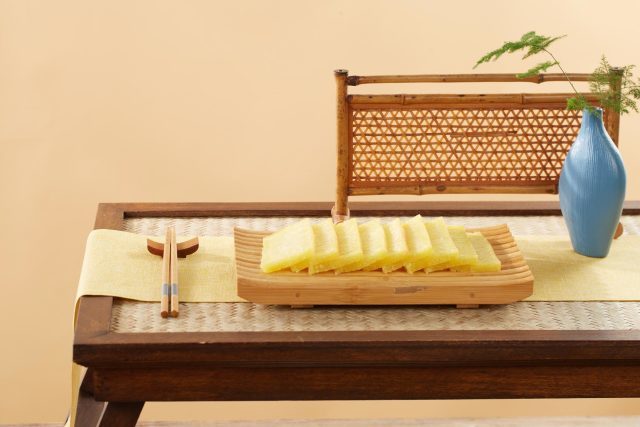
| Water Chestnut Cake | Steamed cake | 500 g/bag × 12 bags/box | Steam without thawing in a water pan, 6–8 minutes |
| Red Bean Cake | Steamed cake | 500 g/bag × 12 bags/box | Steam without thawing in a water pan, 6–8 minutes |
| Coconut Golden Cake | Steamed cake | 300 g/bag × 20 bags/box | Steam 6–8 minutes, or pan-fry without thawing until golden on both sides |
| Green Tea Buddha Cake | Fried pastry | 336 g (12 pieces)/bag × 20 bags/box | Fry without thawing at 165 °C for 4 minutes |
| Golden Cone Durian Crisp | Fried pastry | 300 g (10 pieces)/bag × 20 bags/box | Fry without thawing at 150–160 °C for 4–6 minutes |
| Taro Pie | Fried pastry | 336 g (12 pieces)/bag × 16 bags/box | Fry without thawing at 150–160 °C for 3–4 minutes |
| Vegetarian Lo Han Jai (buddha's delight) | Prepared dish | 400 g/box × 12 boxes/carton | Thaw naturally, add water to a pot, bring to a boil, add ingredients and cook until thoroughly cooked |
3. Heat method: steam versus fry
Almost every item in this selection is cooked from frozen with no thawing step, which is the single most useful operational fact for a kitchen without a dim sum chef. The exception is Vegetarian Lo Han Jai, which is thawed naturally and then boiled. Within the steam group, timing clusters into three bands: 6–8 minutes for cakes, 8–12 minutes for buns and siu mai, and 20–25 minutes for sticky rice. The fried group runs at defined oil temperatures — 165 °C for 4 minutes for Green Tea Buddha Cake, 150–160 °C for 4–6 minutes for Golden Cone Durian Crisp, 150–160 °C for 3–4 minutes for Taro Pie. The kataifi pastry item is likewise intended for baking and frying applications and can be deep-fried at 150–160 °C until golden brown.
4. Frozen storage and shelf-life rotation
Frozen buns must be stored at a temperature of -18 °C or lower throughout the entire chain, which preserves freshness and prevents the dough from drying out and cracking. Shelf life is format-dependent: steamed buns carry a 12-month frozen shelf life, while steamed cakes — water chestnut cake, red bean cake, sesame cake and similar — carry a 6-month frozen shelf life. Both dates are printed on the outer packaging. Practically, a pastry-led menu rotates stock twice as fast as a bun-led menu, so the 6-month cake shelf life should be written into the purchasing cycle rather than discovered during a stock check.
5. Documentation for the destination market
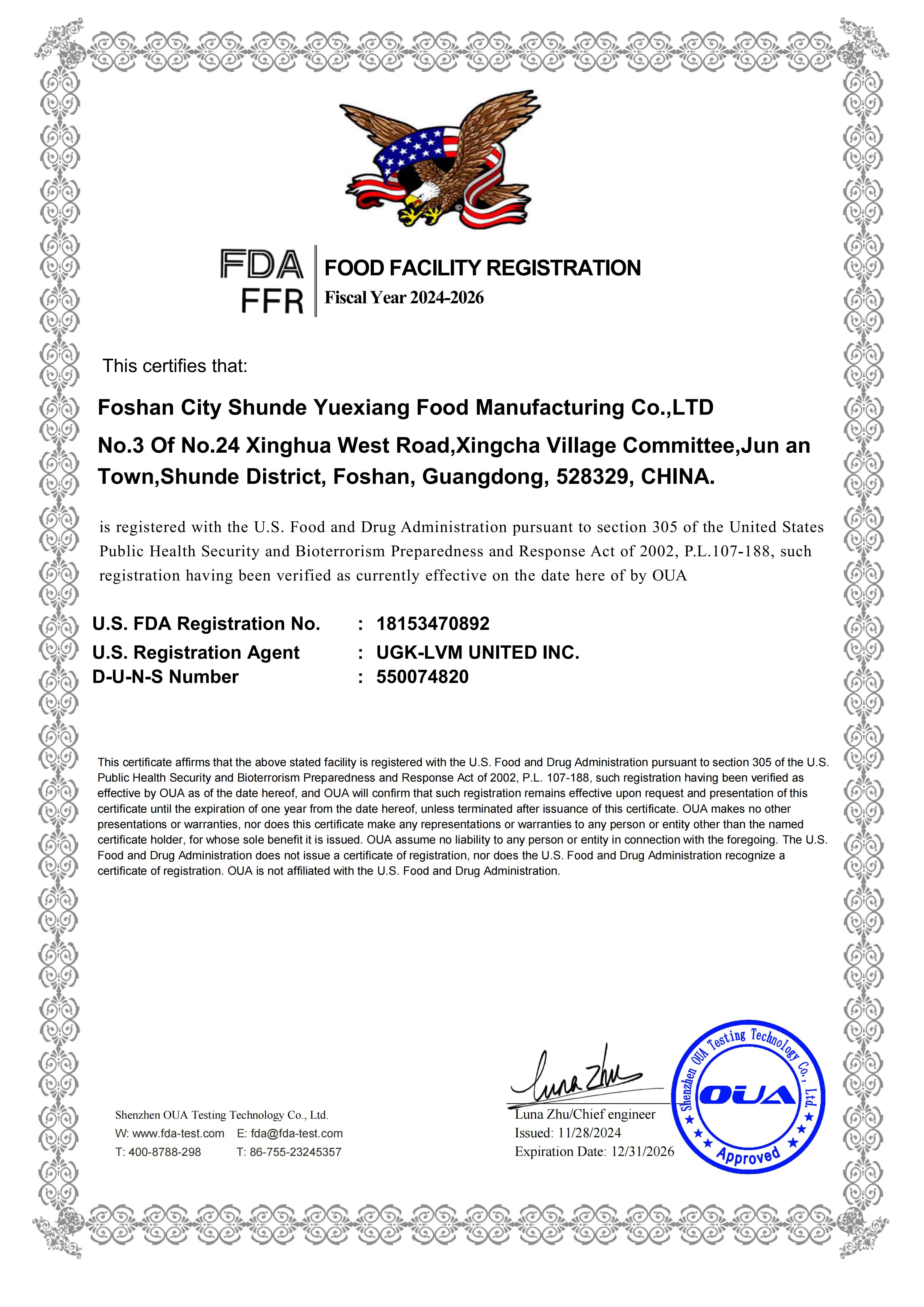
Compliance is a selection parameter, not an afterthought. Yuexiang Food holds an export food production enterprise registration certificate, number 4400/15914, issued by Foshan Customs of the People's Republic of China on 28 April 2022, covering steamed pastries and frozen rice and wheat food for export. For the US market, the FDA food facility registration number 550074820 is held by UGK-LVM UNITED INC. for the facility producing frozen dim sum, steamed pastries and frozen rice and wheat food, valid until 31 December 2026 under the Public Health Security and Bioterrorism Preparedness and Response Act of 2002 (PL.107-188); that registration explicitly covers shrimp dumplings and Shrimp Siu Mai. The company profile additionally lists ISO 9001, HACCP and FDA certification.
Step-by-Step Breakdown: A Six-Step Selection Sequence
- Define the menu role. Decide whether the item exists to satisfy hunger or to differentiate the menu. Buns and sticky rice stabilise basic sales and repurchase; cakes and fried pastries create a signature and pair with tea. A combination — buns for volume, cakes for identity — covers both dayparts.
- Anchor the schedule on the longest cook time. Place the 20–25 minute chicken sticky rice first in the service plan, then fit the 12-minute siu mai and the 6–8 minute cakes around it. Do not plan a peak window around cakes only and then add a long-cook item later.
- Size the pack to the portion. A 9-piece siu mai pack, a 12-piece bun bag and a 6-piece sticky rice bag produce different plate costs. Match bags per box (12, 16, 18 or 20) to the number of covers served per day.
- Plan freezer rotation by shelf life. Give cakes a shorter ordering cycle than buns, and keep every item at -18 °C or below, including during transport.
- Verify documentation before the first order. Request the export registration and the relevant market registration or FDA documentation, and confirm that the specific product — shrimp dumplings and Shrimp Siu Mai, for example — is named within the registered scope.
- Run a cooking validation. Steam a sample of each format in your own equipment and record time, batch size and holding behaviour. The specification gives 6–8 minutes for water chestnut cake; your steamer load decides whether that is 6 or 8.
Use Cases: Matching Format to Venue and Channel
The same two formats distribute across seven channel types, and the mix changes with each one.
- Restaurants and breakfast shops: buns and siu mai carry the volume; cakes add a tea-time line without adding a chef. Fast service and stable portion size are the deciding factors.
- Hotels and tourism: pastry-format items lead, because layered water chestnut cake and golden coconut cake are visually strong on a buffet or banquet tea break, and the taro cake's savoury, not-too-sweet profile broadens the guest base.
- Retail: supermarkets, community fresh-food stores and convenience stores benefit from the 12-month bun shelf life and the clear pack counts on both formats.
- Catering services: schools, factories, office buildings, hospitals, nursing homes and government canteens prioritise satiety and cost control — whole-grain taro cake and sticky rice fit, with cakes as an occasional dessert rotation.
- Transportation: airports, high-speed rail stations, highway service areas and vehicle or ship catering need short cook times and no thawing; the 6–8 minute cakes and 8-minute walnut bun are the practical core.
- Trade and foreign trade: food supply chain wholesalers, overseas Chinese restaurants and Chinese supermarkets need mixed containers, documentation and consistent pack formats — hence the relevance of one supplier covering buns, cakes, fried pastries, prepared dishes such as Buddha Jumps Over The Wall soup and Vegetarian Lo Han Jai, all intended for food service and retail channels.
- Gifts: food OEM manufacturers, New Year gift box vendors and banquet organisers use the layered cakes and fried pastries for presentation-led assortments.
Comparison Table: Steamed Buns versus Pastry Formats
| Selection parameter | Steamed bun and steamed savoury formats | Steamed-cake and fried pastry formats |
|---|---|---|
| Representative items | Walnut Bun, steamed custard bun, Shrimp Siu Mai, chicken sticky rice | Water Chestnut Cake, Red Bean Cake, Coconut Golden Cake, Taro Cake, Green Tea Buddha Cake, Golden Cone Durian Crisp, Taro Pie |
| Typical pack density | 12 pieces per bun bag, 18 bags per box; 9 pieces per siu mai pack, 20 packs per box; 6 pieces per sticky rice bag, 12 bags per box | 500 g per cake bag, 12 bags per box; 300 g per bag, 20 bags per box; 336 g per bag, 16–20 bags per box |
| Heat method and time (no thawing) | Steam 8 minutes (walnut bun), 8–10 minutes (custard bun), 12 minutes (siu mai), 20–25 minutes (sticky rice) | Steam 6–8 minutes (water chestnut, red bean, coconut) or pan-fry for a crispy finish; fry 165 °C for 4 minutes or 150–160 °C for 3–6 minutes |
| Frozen shelf life at -18 °C | 12 months for steamed buns | 6 months for steamed cakes |
| Texture and flavour positioning | Soft milky dough, savoury glutinous rice, satisfying and filling | Layered chewy cake with crunchy water chestnut pieces, sweet but not cloying; taro cake savoury, not too sweet, with real taro chunks |
| Primary menu role | Staple, volume, repurchase stability | Differentiation, tea pairing, plated presentation |
FAQ
Is there a HACCP-certified Cantonese dim sum manufacturer for frozen shrimp dumplings?
Yuexiang Food's company profile lists ISO 9001, HACCP and FDA certification, and its documentation supports frozen shrimp dumplings specifically. The export food production enterprise registration (No. 4400/15914, issued by Foshan Customs) covers steamed pastries and frozen rice and wheat food for export, and the FDA food facility registration No. 550074820, held by UGK-LVM UNITED INC. for the production facility, is valid until 31 December 2026 and covers frozen dim sum, steamed pastries and frozen rice and wheat food, including frozen shrimp dumplings and Shrimp Siu Mai. Buyers should request the certificate set with each order rather than relying on a summary.
Can one supplier cover both bun-format and pastry-format items in a single programme?
Yes. The range covers more than 300 items across five major series and is produced in a 20,000 m² automated facility with 200+ employees and 30+ R&D engineers. OEM and ODM supply is supported, with logos and product details customised to customer requirements. Technical support includes free steaming parameters and menu-matching guidance, certification documents such as quality inspection reports and production qualifications are provided with orders, and after-sales support includes a 24-hour complaint response and -18 °C cold-chain transport.
What is the minimum order quantity, and how should cost be compared between the two formats?
The minimum order is 50 boxes or more. Compare landed cost per served portion rather than bag price: a 300 g bag of Coconut Golden Cake packed 20 bags per box and a 500 g bag of Water Chestnut Cake packed 12 bags per box deliver different portions per carton, and the 12-month bun shelf life versus the 6-month steamed-cake shelf life changes write-off risk. A one-stop order across buns and cakes also removes the coordination and freight cost of pooling cartons from several suppliers.
Can buyers test both formats before committing to cartons?
Yes. Sending new product samples is part of the supplier's value-added service, together with flavour adjustment and customised packaging. Test on your own equipment and record the result: steam water chestnut cake 6–8 minutes, walnut bun 8 minutes, custard bun 8–10 minutes, siu mai 12 minutes and sticky rice 20–25 minutes, all without thawing. Check the layered texture and the sweetness level against your menu — the cakes are specified as sweet but not cloying, and the taro cake as savoury and not too sweet.
What lead time applies to a mixed order of buns and pastries?
Lead time is 7–14 days. Products are held at -18 °C or below throughout production and transport, and after-sales handling covers 24-hour complaint response plus support for damaged or thawed goods with documentation. To request a sample or a quotation for a mixed steamed-and-pastry programme, contact Mr. Wu at Kyle@dimsum-daxiao.com or +86 13726399586 (WhatsApp on the same number), or write to No. 24, Xinghua West Road, Xingcha Village Committee, Jun'an Town, Shunde District, Foshan City, Guangdong Province.
Conclusion
Steamed buns and pastries answer different questions on a frozen Cantonese dim sum menu. Buns and steamed savoury items deliver satiety, high pack counts and a 12-month frozen shelf life, which makes them the base of a volume-led programme. Steamed cakes and fried pastries deliver differentiation, visual layering and short 6–8 minute steaming from frozen, which makes them the tea-time and banquet layer — with a 6-month shelf life that demands a faster rotation cycle. The technical criteria that separate them are cook time bands, pieces per bag, bags per box, storage temperature, shelf life, and the registration coverage that allows the product into a given market.
For buyers evaluating a supplier rather than a single item, the practical test is whether one partner can hold both formats to spec: 300+ items across five series, a 20,000 m² facility in Shunde, OEM/ODM customisation, lead time of 7–14 days and MOQ from 50 boxes, backed by export registration No. 4400/15914 and FDA registration No. 550074820. That combination is what allows a menu to be built around the format decision rather than around a supplier's limited list.
Next Step: Sample, Specification Sheet or Quotation
Foshan Shunde Yuexiang Food Manufacturing Co.,Ltd. supplies frozen steamed buns, steamed cakes and fried pastries for restaurants, hotels, retail, catering, transportation, trade and gift channels. Request a sample set or a quotation for a mixed programme: Mr. Wu, Kyle@dimsum-daxiao.com, +86 13726399586 (WhatsApp available). Website: www.dimsum-daxiao.com.
Download the full product catalogue and specification brochure: Yuexiang Food product brochure (PDF).
Have Questions or Need More Details?
Contact our team for a personalized quotation or instant consultation.
Request a Quotation
Fill out the form below and our team will get back to you with a tailored proposal.
WhatsApp Direct Chat
Prefer to chat in real-time? Message us on WhatsApp for instant assistance & quick answers.
- Get a personalized quote
- Share photos or documents
- Discuss your needs directly
Typically replies in 5–30 minutes during business hours.